 Enlarge graphic
 KNAACK.IT · Infographic
Many people now pay for an AI subscription every month. Most still do not know what they receive in return. ChatGPT, Claude and other applications show limits or the next reset, but they do not provide a bill for the tokens actually processed.
In my own use of Codex, I have also noticed that quotas are occasionally reset early or extended. This is not guaranteed, but for intensive users it increases the value once again.
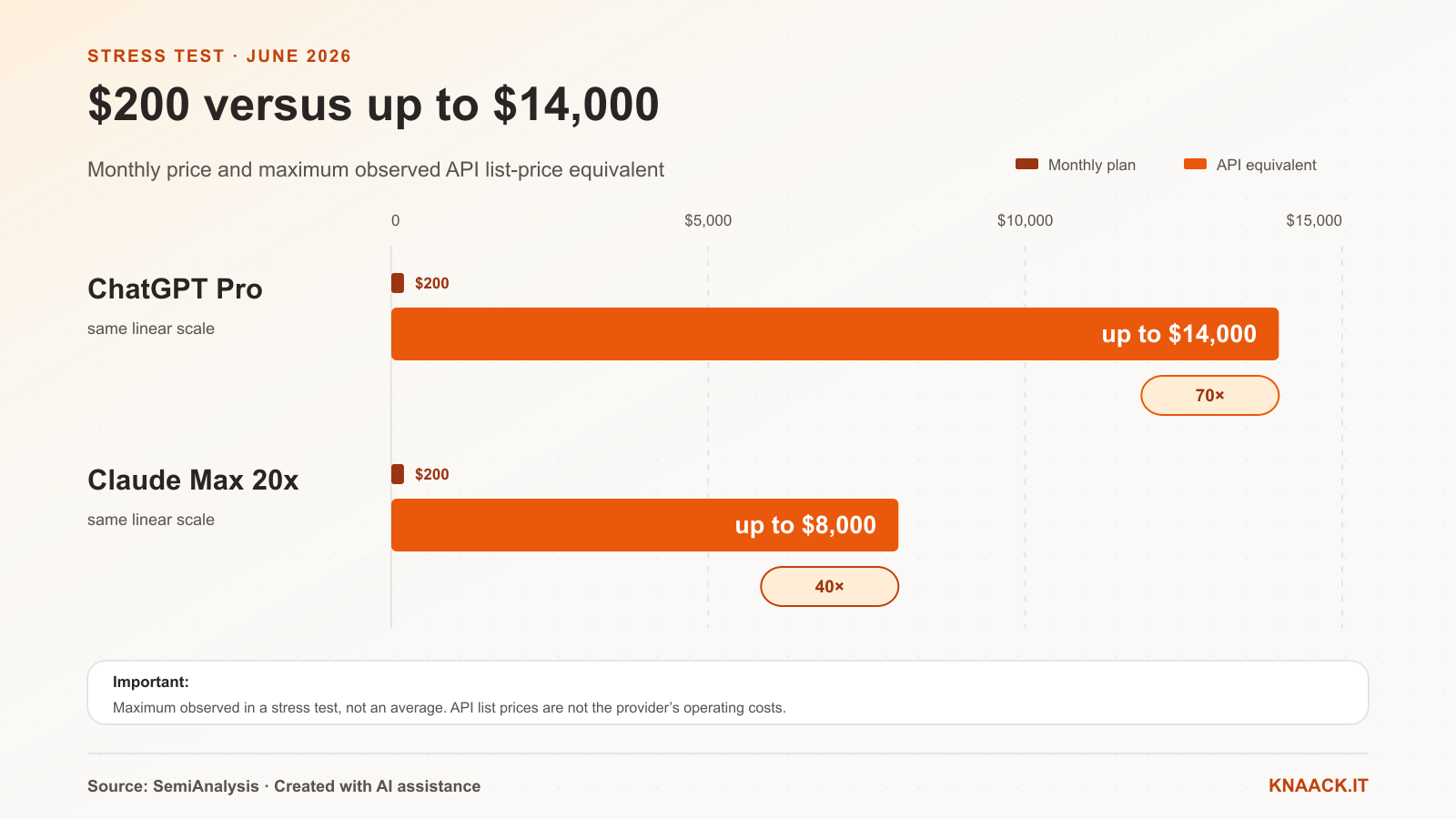
A stress test from June 2026 shows how large the difference can become: a $200 AI subscription enabled usage that would have cost up to $14,000 at the public API list prices in effect at the time.
A $200 AI subscription can provide intensive users with several thousand dollars’ worth of API usage.
That sounds difficult to reconcile at first. A subscription and an API, however, are not the same product.
Subscriptions and APIs use different pricing models
A token is a small unit of text. An API charges separately for input and output. Long conversations and coding agents process far more than the text that eventually appears on screen. They read files, use tools and send parts of the previous conversation back to the model. Through an API, every one of these steps appears on the bill.
A subscription works differently. Users pay a fixed monthly fee and receive access to models and tools within the limits that apply at the time. They do not buy a fixed number of tokens. Providers decide which models are included, how high the limits are and when they reset.
ChatGPT Plus currently costs $20 per month. Higher-tier plans from OpenAI and Anthropic cost $100 or $200. Some products allow users to buy additional credits after reaching the included limits.
What do current models cost through the API?
Prices now differ considerably. As of July 2026, the list prices for some of the most capable current models are:
| Model | Input per 1M tokens | Output per 1M tokens |
|---|---|---|
| GPT-5.6 Sol | $5 | $30 |
| GPT-5.6 Terra | $2.50 | $15 |
| GPT-5.6 Luna | $1 | $6 |
| Claude Opus 5 | $5 | $25 |
| Claude Fable 5 | $10 | $50 |
| Kimi K3 | $3 without caching | $15 |
Cached inputs can be cheaper, while tools and particularly long inputs may add further costs. The most expensive model therefore does not need to handle every task. Smaller models are often sufficient if they reliably deliver the required quality.
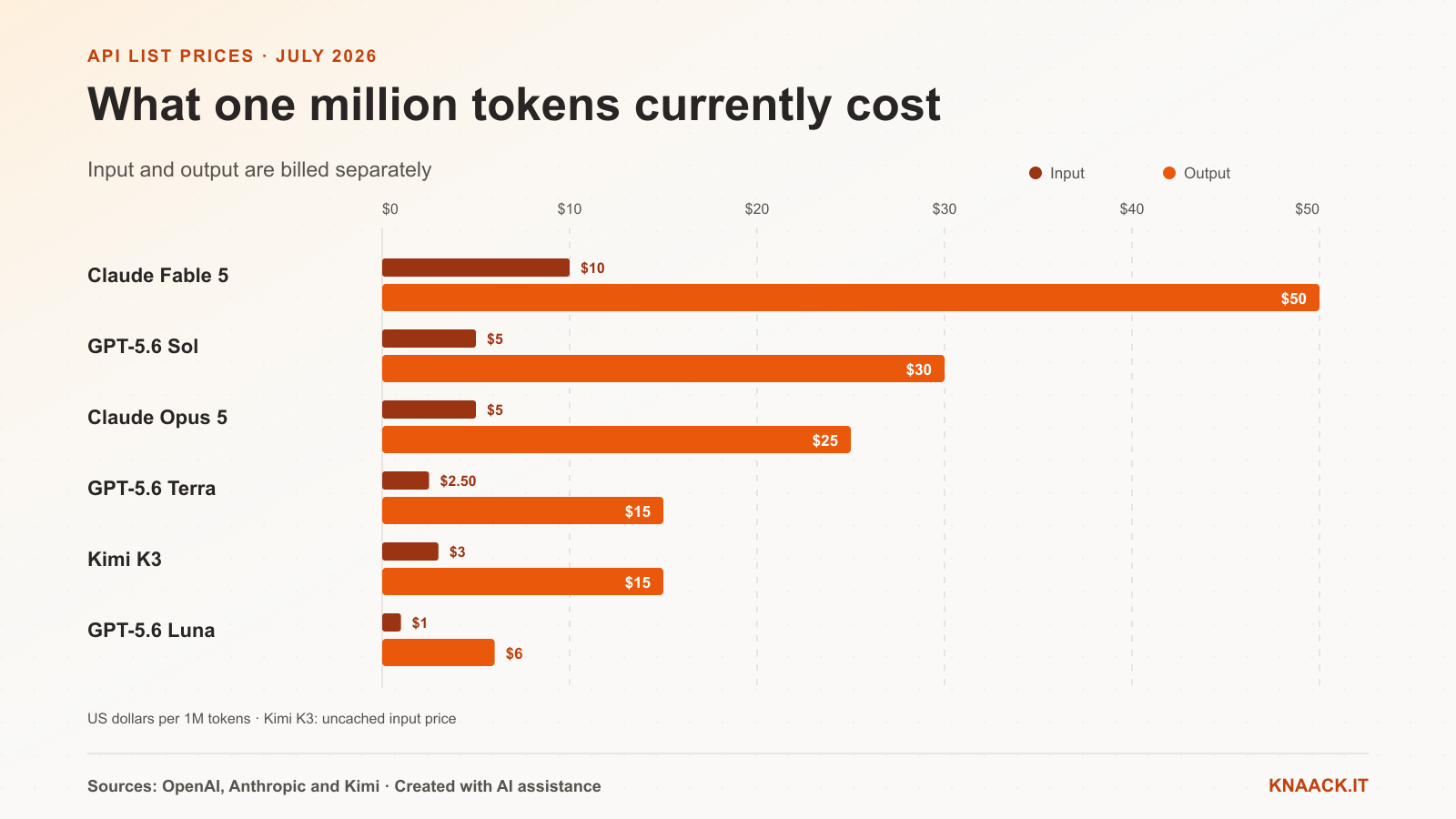
For every model in this comparison, output costs more than input. The price differences between models are substantial. As of July 2026. Created with AI assistance.
$200 versus up to $14,000
In June 2026, SemiAnalysis stress-tested paid OpenAI and Anthropic plans using long-running coding and agent tasks until it reached the observed usage limits. It then compared that consumption with the API list prices in effect at the time.
| Subscription | Monthly price | Maximum API list-price equivalent in the test |
|---|---|---|
| ChatGPT Pro | $200 | approximately $14,000 |
| Claude Max 20x | $200 | approximately $8,000 |
These are not average figures, nor are they a recalculation based on today’s models. They show the maximum usage observed in that particular stress test. Even with that qualification, the result is striking: intensive users can receive a calculated API equivalent worth many times their monthly fee.
The API list price does not represent the provider’s actual operating cost. In addition, many subscribers use nowhere near their limits. That is also part of the economics behind a flat monthly price.
The comparison shows maximum values from a stress test, not average usage. API list prices are not the same as a provider’s actual operating costs. Created with AI assistance.
Why can subscriptions be so inexpensive?
A subscription is designed for personal use within an application. Providers can change models, speed and limits. An API, by contrast, can be automated, integrated into products and billed precisely.
At the same time, providers are competing for market share. An attractive subscription drives adoption, habitual use and long-term retention. Caching, high utilisation and more efficient models also reduce costs. Without internal figures, it is impossible to determine whether an individual plan is profitable. It is reasonable, however, to assume that less active customers subsidise part of the heaviest usage.
Why extremely cheap offers from China make me sceptical
Kimi and MiniMax offer subscriptions that resemble flat-rate plans. In practice, they provide large quotas that reset regularly. Their API prices are also low: Kimi K3 costs $3 per million uncached input tokens and $15 for output.
These prices exist in a market where China subsidises computing capacity, model development and, in some cases, even the use of AI models. This does not prove that a particular subscription is directly funded by the state. It does show that low prices should not be attributed exclusively to more efficient technology.
Kimi also states that inputs and responses from private users may be used for model training after anonymisation. According to the company, the data is stored in China. Different commitments apply to enterprise customers.
In my view, scepticism is therefore justified. A low price may demonstrate technical progress, but it may also be part of a long-term strategy to gain users and market share quickly. The monthly fee is only one part of the decision.
With an exceptionally cheap offer, the question should not end with the monthly price. It matters just as much what else you may be paying with.
When are both a subscription and an API viable options?
For personal work and non-sensitive content, a subscription is often the most economical option. Once personal data, customer data, contracts or internal company information are involved, price is no longer the most important criterion.
The company then needs to establish which data is sent to which provider, which model is actually being used and what contractual commitments apply. Under these conditions, a personal AI subscription may be entirely unsuitable. A business plan or an API often provides stronger contractual terms, but that does not automatically make it suitable for every use case.
Sometimes the only suitable option is a European provider with servers in Europe and an appropriate model. For particularly sensitive data, a self-hosted open-weights model may be the better choice. I explain why server location, provider jurisdiction and the model itself need to be assessed separately in “GDPR and the CLOUD Act in the Age of AI: Data Security for Businesses”.
When an API is viable, the most expensive model should not be the automatic choice. A smaller model is the better option if realistic tests show that it reliably meets the required quality. I examine the different levels of control offered by closed APIs and self-hosted models in “Closed Models, Open Weights and Open Source in the Enterprise”.
How long will the party stay this cheap?
OpenAI and Anthropic submitted confidential paperwork for potential initial public offerings in June 2026. This does not prove that their subscription prices are being kept low for that reason. It does show how important growth and reach have become.
At the same time, better hardware and more efficient models continue to reduce costs. Capable AI subscriptions may therefore remain inexpensive. Higher prices, stricter limits or new flagship models available only through additional credits are just as plausible.
For intensive users, the value today is often exceptional. The open question is whether this relationship will last or whether it is still part of the current international competition.
Sources (12)
- SemiAnalysis — Stress test of AI subscriptions · accessed
- OpenAI — GPT-5.6 models and pricing · accessed
- OpenAI — ChatGPT Pro features · accessed
- OpenAI — ChatGPT Plus pricing and features · accessed
- Anthropic — Claude Opus 5 model and pricing · accessed
- Anthropic — Claude Fable 5 model and pricing · accessed
- Kimi — Subscription prices and quotas · accessed
- Kimi — Kimi K3 API pricing · accessed
- Kimi — Use and storage of submitted data · accessed
- MiniMax — Token Plan pricing and quotas · accessed
- City of Shanghai — Subsidies for computing capacity and model usage · accessed
- Reuters — OpenAI and Anthropic prepare for IPOs · accessed
Sources
- SemiAnalysis — Stress test of AI subscriptions · accessed
- OpenAI — GPT-5.6 models and pricing · accessed
- OpenAI — ChatGPT Pro features · accessed
- OpenAI — ChatGPT Plus pricing and features · accessed
- Anthropic — Claude Opus 5 model and pricing · accessed
- Anthropic — Claude Fable 5 model and pricing · accessed
- Kimi — Subscription prices and quotas · accessed
- Kimi — Kimi K3 API pricing · accessed
- Kimi — Use and storage of submitted data · accessed
- MiniMax — Token Plan pricing and quotas · accessed
- City of Shanghai — Subsidies for computing capacity and model usage · accessed
- Reuters — OpenAI and Anthropic prepare for IPOs · accessed